Damon Runyon identifies today’s most brilliant early career scientists and funds their innovative cancer research.
- Today’s Promising Areas of Cancer Research
- What is Cancer?
- A Broken Pipeline?
A Generation of Science at Risk
- ARISE Report
Early Career Scientists and High-Risk, High Reward Research - American Academy of Arts and Sciences
- Why We’re Losing the War on Cancer (And How To Win It)
Clifton Leaf - Fortune Magazine
History of the Damon Runyon Cancer Research Foundation
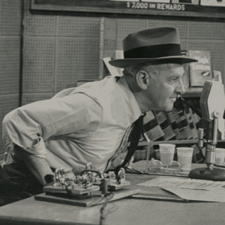
“Good evening Mr. and Mrs. America and all the ships at sea”
It all began in 1946 with the death from cancer of Damon Runyon, the journalist and short story writer, whose beloved Broadway stories were later transformed into the hit show Guys & Dolls. His good friend, Walter Winchell, renowned journalist and radio commentator, went on his famous radio program and appealed to “Mr. and Mrs. America” for contributions to help fight cancer. The response was overwhelming, enabling Winchell to establish the “Damon Runyon Cancer Memorial Fund” with the mission of supporting the most promising early career scientists across the nation. He led the fund, with the help of such celebrities as Marlene Dietrich, Bob Hope, Milton Berle, Marilyn Monroe and Joe DiMaggio, until his own death from cancer in 1972.
Damon Runyon Award Programs History
Since 1946, the Damon Runyon Cancer Research Foundation has invested over $220 million in the best and brightest scientists in the nation. The Foundation’s three programs - the Damon Runyon Fellowship Award, the Damon Runyon Clinical Investigator Award and the Damon Runyon-Rachleff Innovation Award - have supported the innovative work of more than 3,200 cancer researchers to date. Eleven Damon Runyon scientists have received the Nobel Prize and many others have made important discoveries that have led – and are continuing to lead – to new ways to prevent, diagnose and treat all forms of cancer.
About Walter Winchell
It has been said that during the 1940s you could take a walk on a Sunday summer evening and not miss a word of Winchell’s radio program coming out of the windows of every home you passed. At the height of his popularity in the 1940s, 55 million people listened to his radio show, and his column ran in more than 2,000 daily papers. Winchell created “gossip journalism,” using his razor-sharp wit and self-styled “slanguage” to describe the goings on of the celebrities of the day – stars, socialites and gangsters. He was one of the most influential, colorful and controversial personalities of the mid-20th Century.
About Damon Runyon
Born in 1884, Damon Runyon began his journalistic career in Colorado before moving to New York City in 1911. As a sportswriter and journalist for the Hearst organization, he revolutionized the coverage of baseball with his often hilarious descriptions that went well beyond the game at hand. He spent his free time on the Great White Way, hanging out at Lindy’s and the Stork Club and socializing with the personalities of the day: Al Capone, Jack Dempsey, Babe Ruth and, of course, Walter Winchell. He used the worlds of gambling, horse racing, and speakeasies for his beloved short stories, known for capturing the language and dubious philosophies of his characters (Nathan Detriot, Harry the Horse, the Lemon Drop Kid) in a “Runyonesque” fashion. These characters became the stars of the hit Broadway show Guys & Dolls after his death from throat cancer in 1946.