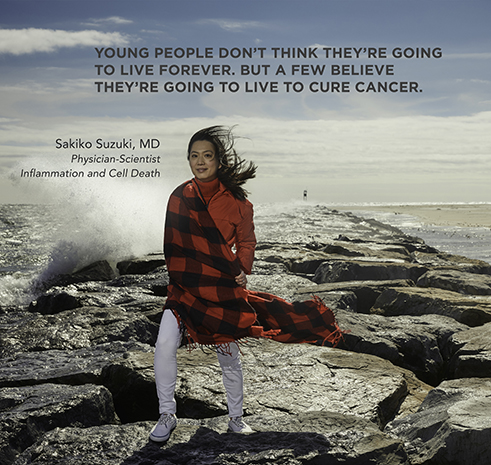
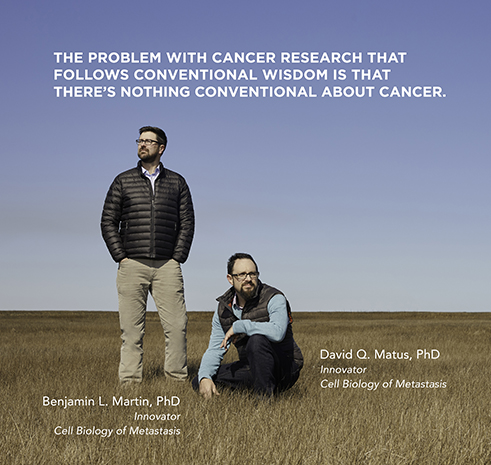
To accelerate breakthroughs, the Damon Runyon Foundation provides today's best young scientists with funds to pursue innovative cancer research.
- Today’s Promising Areas of Cancer Research
- What is Cancer?
- A Broken Pipeline?
A Generation of Science at Risk
- ARISE Report
Early Career Scientists and High-Risk, High Reward Research - American Academy of Arts and Sciences
- Why We’re Losing the War on Cancer (And How To Win It)
Clifton Leaf - Fortune Magazine
2005 New Discoveries and Honors in Cancer Research
2011 | 2010 | 2009 | 2008 | 2007 | 2006 | 2005
Members of the Damon Runyon scientific circle regularly publish findings on the latest cancer research and are frequently recognized for their contributions to the fight against cancer. Below, you will find new discoveries in cancer research and the most recent honors bestowed upon Damon Runyon Cancer Research Foundation awardees, alumni and friends.
December 22, 2005
Wolfgang Fischle, PhD (Damon Runyon Fellow '02-'05) described the latest groundbreaking research on how distinct biochemical modifications to proteins called histones can control gene expression. Dr. Fischle’s paper was published in this week’s Nature. His work extends the hypothesis that regulation of gene expression is the result of a carefully orchestrated process involving multiple changes to histone proteins.
December 21, 2005
William R. Sellers, MD (Damon Runyon Clinical Investigator '01-'05) reported that a new class of drugs called MEK inhibitors selectively suppresses growth of cancer cells and tumors that harbor a mutation in the BRAF gene. BRAF is a protein that acts as a critical regulator of cellular growth, differentiation, and survival.
December 13, 2005
Marc I. Damelin, PhD (Damon Runyon Fellow '03-'06) has identified a characteristic of stem cells that may reveal an early step in carcinogenesis. Dr. Damelin's research shows that stem cells are susceptible to a specific error during cell division that results in severe damage to chromosome structure and increases genomic instability. These findings were published in the journal Cancer Cell.
November 29, 2005
Gregory J. Hannon, PhD (Damon Runyon Fellow '92-'94) was featured as one of the “Best & Brightest” of 2005 in the December Genius Issue of Esquire. Dr. Hannon’s work with a recently discovered class of gene regulators called microRNAs is recognized as the science “Breakthrough of the Decade."
October 24, 2005
Carol L. Prives, PhD (Damon Runyon Fellow '68-'70) was elected to the Institute of Medicine, one of the highest honors that can be earned by a U.S. scientist. Dr. Prives is the DaCosta Professor of Biology and chair of the Department of Biological Sciences at Columbia University, where she studies how mutations in the p53 tumor suppressor gene contribute to cancer.
September 29, 2005
Pehr A.B. Harbury, PhD (Damon Runyon Fellow '95-'97) has been selected for a Pioneer Award by the Director of the National Institutes of Health. The award supports exceptionally creative scientists who take innovative approaches to major challenges in biomedical research.
September 5, 2005
Peter P. Lee, MD (Damon Runyon Scholar '01-'03) has developed a new way to assess the risk of breast cancer recurrence. Dr. Lee looked at what types of immune cells were present in the lymph nodes of 77 breast cancer patients and found that the pattern of immune cells could predict the chances that the cancer would recur.
August 26, 2005
Chad A. Cowan, PhD (Damon Runyon Fellow '02-'05) and colleagues have developed a new technique for obtaining human embryonic stem cells. The researchers were able to induce adult skin cells to become embryonic stem cells by fusing them with existing stem cells. The new technique may permit researchers to create new human embryonic stem cell lines without using human embryos.
August 22, 2005
Preet M. Chaudhary, MD, PhD (Damon Runyon Fellow '95-'98) found that a human herpesvirus 8 (HHV8) protein previously thought to help the virus evade attack by the immune system has a direct role in the development of lymphoma. He finds that the protein, called vFLIP13, activates a key pathway involved in the production of lymphocytes and its expression can cause overproduction of these cells, resulting in a tumor.
August 21, 2005
Weidong Wang, PhD (Damon Runyon Fellow '93-'95) has discovered a new gene, called FANCM, that is involved in the repair of damaged DNA. Mutation of this gene is responsible for a form of the childhood disease called Fanconi anemia, which causes increased susceptibility to many types of cancer.
August 1, 2005
The Damon Runyon Foundation has announced a new partnership with Berlex, Inc., a U.S. affiliate of Schering AG, Germany (NYSE:SHR). Berlex Oncology has committed $134,000 over three years to support Don X. Nguyen, PhD (Damon Runyon Fellow '05-'08). Dr. Nguyen's research focuses on breast cancer and understanding the genetic basis of its often-lethal spread (metastasis) to the lung.
July 13, 2005
Neal G. Copeland, PhD (Damon Runyon Fellow '77-'79) and colleagues have discovered a new method that improves the accuracy and speed with which cancer-causing genes are found. Dr. Copeland developed the method in mice and first tested its ability to find genes involved in lymphoma. Application of the technique to human cancer cells has the potential to uncover cancer's weak points and lead to better treatments.
June 9, 2005
Gregory J. Hannon, PhD (Damon Runyon Fellow '92-'94) found a new class of oncogene that plays a role human cancer development. Dr. Hannon was a key player in the recent discovery of a new class of gene regulators called microRNAs. Now Hannon and his colleagues show that microRNAs can serve as oncogenes in several types of human cancer.
May 27, 2005
Tom Curran, PhD, FRS (Damon Runyon Fellow '82-'84) was elected a Fellow of the Royal Society of London for Improving Natural Knowledge. Dr. Curran was honored for his work on the molecular basis of cancer and joins such distinguished scientists as Isaac Newton, Charles Darwin and Stephen Hawking.
May 24, 2005
Paul Talalay, MD (Damon Runyon Fellow '50-'52) was awarded the 2005 Linus Pauling Institute Prize for Health Research for his pioneering discoveries of dietary phytochemicals that protect against cancer. Dr. Talalay is the John Jacob Abel Distinguished Service Professor of Pharmacology and the Director of the Laboratory for Molecular Pharmacology at the Johns Hopkins University School of Medicine.
May 14, 2005
Richard J. O'Reilly, MD (Damon Runyon Board Member) was the recipient of the 2005 Pediatric Oncology Award from the American Society of Clinical Oncology for his groundbreaking work in the field of bone marrow transplantation.
May 3, 2005
Craig B. Thompson, MD (Damon Runyon Board Member) was elected to the National Academy of Sciences, one of the highest honors that can be earned by a U.S. scientist. Dr. Thompson is the Scientific Director of the Abramson Family Cancer Research Institute at the University of Pennsylvania, where he studies the genes that regulate apoptosis (cell death) and investigates their application in treating cancer.
April 6, 2005
Gregory J. Hannon, PhD (Damon Runyon Fellow '92-'94) won the 2005 AACR Award for Outstanding Achievement in Cancer Research. He is a pioneer in the field of RNA interference (RNAi). One focus of his laboratory is to harness RNAi technology to search the human genome for novel therapeutic targets for cancer.
David Livingston, MD (Damon Runyon Board Member) was the winner of the 2005 AACR-G.H.A. Clowes Memorial Award. The award, sponsored by Eli Lilly and Company, recognizes outstanding recent accomplishments in basic cancer research.
---
James J. Manfredi, PhD (Damon Runyon Fellow '83-'85) discounted the role of SV40 virus in malignant mesotheliomas (cancers associated with exposure to asbestos). The possibility that SV40 virus might contribute to this type of cancer came to light when it was discovered that polio vaccines widely used in the 1960's were contaminated with the virus.
April 4, 2005
Ramesh Shivdasani, MD, PhD (Damon Runyon Scholar '98-'99) found a molecular pathway suspected in precancerous stomach lesions, which may lead to improved diagnosis and prevention of stomach-esophageal cancer.