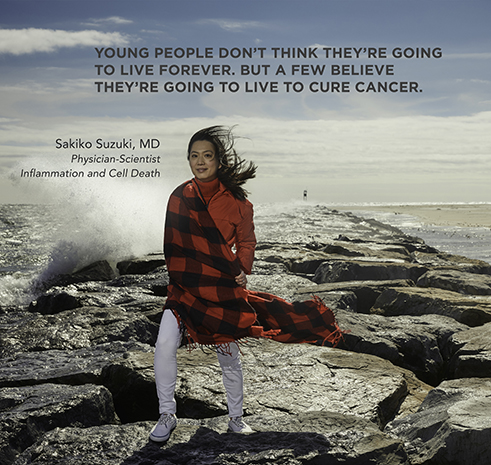
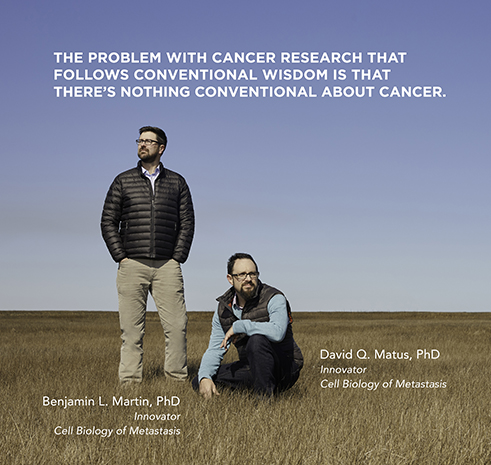
To accelerate breakthroughs, the Damon Runyon Foundation provides today's best young scientists with funds to pursue innovative cancer research.
- Today’s Promising Areas of Cancer Research
- What is Cancer?
- A Broken Pipeline?
A Generation of Science at Risk
- ARISE Report
Early Career Scientists and High-Risk, High Reward Research - American Academy of Arts and Sciences
- Why We’re Losing the War on Cancer (And How To Win It)
Clifton Leaf - Fortune Magazine
2007 New Discoveries and Honors in Cancer Research
2011 | 2010 | 2009 | 2008 | 2007 | 2006 | 2005
Members of the Damon Runyon scientific circle regularly publish findings on the latest cancer research and are frequently recognized for their contributions to the fight against cancer. Below, you will find new discoveries in cancer research and the most recent honors bestowed upon Damon Runyon Cancer Research Foundation awardees, alumni and friends.
October 8, 2007
Nine members of the Damon Runyon Foundation circle were elected to the Institute of Medicine, one of the highest honors that can be earned by a U.S. scientist.
DAMON RUNYON COMMITTEE MEMBERS
Webster K. Cavenee, PhD (Former Board Member and Fellowship Award Committee Member '89-'93) Director, Ludwig Institute for Cancer Research, and Distinguished Professor, University of California, San Diego, California
William G. Kaelin, Jr., MD (Clinical Investigator Award Committee Member) Investigator, Howard Hughes Medical Institute, and Professor, Harvard Medical School, Dana-Farber Cancer Institute, Boston, Massachusetts
Ronald Levy, MD (Board Member, Innovation Award Selection Committee Member, Clinical Investigator Sponsor and Clinical Investigator Award Committee Member '00-'07) Professor and Chief, Division of Oncology, Stanford University School of Medicine, Stanford, California
Jeffrey V. Ravetch, MD, PhD (Fellowship Award Committee Member '96-'00) Theresa and Eugene M. Lang Professor and Head, Leonard Wagner Laboratory of Molecular Genetics and Immunology, The Rockefeller University, New York, New York
DAMON RUNYON FELLOWSHIP SPONSORS
James P. Allison, PhD, Investigator, Howard Hughes Medical Institute, and Chair, Immunology Program, Sloan-Kettering Institute, New York, New York
Kathryn Lee Calame, PhD, Professor, Departments of Microbiology, Biochemistry, and Molecular Biophysics, Columbia University, New York, New York
Louis J. Ptácek, MD, Investigator, Howard Hughes Medical Institute, and John C. Coleman Distinguished Professor of Neurology, University of California, San Francisco, California
Matthew P. Scott, PhD, Investigator, Howard Hughes Medical Institute, and Professor of Developmental Biology, Genetics, and Bioengineering, Stanford University School of Medicine, Stanford, California
Jonathan G. Seidman, PhD, Henrietta B. and Frederick H. Bugher Professor of Genetics, Harvard Medical School, Boston, Massachusetts
September 26, 2007
The Memorial Sloan-Kettering Cancer Center, New York, has announced the recipients of the 2007 Paul Marks Prize for Cancer Research, which honors young investigators who have made significant contributions to the basic understanding and treatment of cancer. The winners are Angelika Amon, PhD (Damon Runyon Fellowship Sponsor) of the Massachusetts Institute of Technology, Cambridge, who studies how chromosomes segregate during cell division; Todd R. Golub, MD (Damon Runyon Fellowship Sponsor, Damon Runyon Clinical Investigator Award Mentor, and Innovation Award Committee Member) of the Dana-Farber Cancer Institute and the Broad Institute of Harvard and MIT, Cambridge, who employs genomic approaches to better classify subtypes of cancer; and Gregory J. Hannon, PhD (Damon Runyon Fellow '92-'94, Damon Runyon Fellowship Sponsor and Innovation Award Committee Member) of the Cold Spring Harbor Laboratory, Cold Spring Harbor, who uses model systems to study the biochemistry and biology of the RNA interference mechanism.
September 16, 2007
Ralph M. Steinman, MD (Damon Runyon Clinical Investigator Mentor) of The Rockefeller University, New York, has been awarded the highly prestigious Lasker Medical Prize for 2007. Dr. Steinman discovered dendritic cells, which mediate the immune response of the body to microbial or viral invasion by stimulating a variety of lymphocytes (B, T and NK cells). His current research involves investigating ways of using dendritic cells to understand the pathogenesis and therapy of HIV infection and regulate the body’s response to tumors, infections, and autoantigens. The award is highlighted in an article in The New York Times.
July 10, 2007
In the July issue of the prestigious journal Cancer Cell, David A. Guertin, PhD (Damon Runyon Fellow '03-'06) reviews recent progress in defining the mTOR pathway, a critical signaling system with growing relevance to cancer. For example, the drug rapamycin, which inhibits mTOR, is currently in clinical trials for a variety of tumor types. Dr. Guertin and his mentor, Dr. David Sabatini, have made seminal contributions to understanding how the mTOR pathway is deregulated in human cancers.
July 3, 2007
Elizabeth H. Blackburn, PhD (Innovation Award Committee Member) was named one of The Time 100 – Time magazine’s annual list of men and women whose power, talent or moral example is transforming the world. Her story was also featured in The New York Times.
July 2, 2007
Nobel Laureate, Susumu Tonegawa, PhD (Damon Runyon Fellow '69-'70) and colleagues reported on a breakthrough with therapeutic implications for Fragile X syndrome, the most common genetic form of mental retardation and autism. Tonegawa and his co-workers found that inhibition of p21-activated kinase reverses the symptoms of fragile X syndrome in mouse models of the disease.
June 30, 2007
Colleen Delaney, MD, MSc (Damon Runyon-Novartis Clinical Investigator '07-'10) and William M. Grady, MD (Damon Runyon-Lilly Clinical Investigator '02-'07) were featured in Quest, a newsletter from the Fred Hutchinson Cancer Research Center, Seattle, Washington, for their groundbreaking research in cord blood transplantation and colon cancer, respectively.
June 29, 2007
In the June 29 issue of the journal Cell, Howard Y. Chang, MD, PhD (Kenneth G. and Elaine A. Langone Scholar of the Damon Runyon Foundation '06-'08 and Fellowship Sponsor) and John L. Rinn, PhD (Damon Runyon Fellow '05-'07) report that non-coding RNAs are involved in regulating HOX gene expression, an important player in how cells know where they are in the body and what they are supposed to become. This finding has significant implications in cancer biology since HOX is improperly regulated in some types of cancer and HOX is key in keeping stem cells from differentiating into the wrong tissue. Understanding how non-coding RNAs affect HOX gene expression is likely to have therapeutic implications for cancer patients.
June 27, 2007
Gregory R. Reyes, PhD (Damon Runyon Fellow '83-'85) has joined Cyclacel Pharmaceuticals as Senior Vice President, Research. Dr. Reyes has more than 22 years of experience in leadership roles at a number of biotechnology and pharmaceutical companies, including Schering-Plough and, most recently, Pfizer, where he served as Vice President, Biology, Discovery Research, within Pfizer Global Research & Development. Cyclacel is a biopharmaceutical company dedicated to the discovery, development and commercialization of novel, mechanism-targeted drugs to treat human cancers and other serious disorders.
June 26, 2007
Sean B. Carroll, PhD (Damon Runyon Fellow '83-'85) was featured in the June 26 edition of The New York Times for his leading work in evolution and developmental biology.
June 20, 2007
Eli Canaani, PhD (Damon Runyon Fellow '75) and colleagues at The Ohio State University, Columbus, Ohio, reported elevated levels of specific non-coding small RNAs, called miRNAs, in leukemias triggered by the fusion protein ALL-1 (also termed MLL). These miRNAs suppress the expression of target genes and may be implicated in leukemogenesis. Their findings were published in the prestigious journal, Proceedings of the National Academy of Science.
June 7, 2007
Gregory J. Hannon, PhD (Damon Runyon Fellow '92-'94 and Innovation Award Committee Member) reports on a groundbreaking discovery in the June 6 issue of Nature. Hannon and collaborators describe a class of microRNAs called miR-34a-c, whose expression level mirrors that of p53, a critical regulator in cancer cells. This report provides evidence that miR-34a-c may play a central role in orchestrating the p53 tumor suppressor function.
June 6, 2007
Bruce R. Conklin, MD (Damon Runyon Fellow '90) and colleagues successfully connected human embryonic kidney cells and mouse embryonic stem cells with silicon nanowires, a significant advance toward the futuristic goal of linking cells to each other and to external devices.
---
Derek J. Rossi, PhD (Damon Runyon Fellow '03-'06) and coworkers report on new clues as to why blood cancers, like leukemia, occur in people as they age. Dr. Rossi found that even though blood-forming stem cells rarely divide, they still accumulate DNA damage, which is passed on to the blood and immune system cells they go on to make. Rossi’s work was published in the June 6 issue of the prestigious journal, Nature.
June 5, 2007
The lymphoma drug Bexxar, brainchild of Mark S. Kaminski, MD (Damon Runyon Fellow '83-'85), shows promising results in follicular lymphoma patients. Eight years after being treated with Bexxar, 86% of patients were alive and had not experienced a relapse of their cancer. Bexxar decreased tumor mass in 95% of patients and caused a complete remission in 75% of patients treated with the radioimmunotherapy. Kaminski reported the results at the American Society of Clinical Oncology in Chicago this June.
June 1, 2007
Jennifer A. Benanti, PhD (Damon Runyon Fellow '04-'07) and her coworkers report interesting findings in telomere biology using a yeast model. Benanti showed that the amount of telomerase bound to telomeres may be an important control point for controlling telomere length, a process previously implicated in carcinogenesis and aging.
---
Chad G. Pearson, PhD (Damon Runyon Fellow '05-'08) and coworkers identified the IFT80 gene as the underlying cause of Jeune asphyxiating thoracic dystrophy, a genetic disease that leads to death in infancy, thereby establishing the first association of a defective intraflagellar transport protein with human disease.
May 31, 2007
H. Michael Shepard, PhD (Damon Runyon Fellow '78-'80) and Robert A. Weinberg, PhD (Scholar Award Review Panel Member and Damon Runyon Fellowship Sponsor) were awarded the 19th annual Warren Alpert Foundation Prize at Harvard Medical School, in recognition of their contribution to the development of the breast cancer therapy Herceptin, the first target-directed cancer treatment for solid tumors.
May 30, 2007
Martin D. Abeloff, MD (Clinical Investigator Award Committee Member) was awarded the 2007 Distinguished Service Award for Scientific Achievement from the American Society of Clinical Oncology for his leadership and impact in the field of patient-oriented breast cancer research.
Napoleone Ferrara, MD (Innovation Award Committee Member) was awarded the 2007 Science of Oncology Award from the American Society of Clinical Oncology for his groundbreaking research with the vascular endothelial growth factor protein and the development of the anti-angiogeneic drug bevacizumab. The Award recognizes the contributions of innovative basic scientists in cancer research.
May 23, 2007
Howard Y. Chang, MD, PhD (Kenneth G. and Elaine A. Langone Scholar of the Damon Runyon Foundation '06-'08) and colleagues report on a technique that is poised to revolutionize cancer diagnosis and monitoring. In the latest issue of Nature Biotechnology, the research team reports that most of the genetic activity of a tumor can be measured by looking at images from radiology scans like the standard CT scans that most cancer patients routinely get. This technology could avoid the pain and risk of infection associated with surgical biopsies, while providing information that could lead to a more personalized diagnosis and treatment - one based on the unique genetic features of an individual patients’ disease. Importantly, this approach would not destroy the tissue so the same site could be tested again and again, providing important information about how the tumor is responding to therapy.
May 15, 2007
Bruce W. Stillman, PhD, FRS (Damon Runyon Fellow '79-'81), President of Cold Spring Harbor Laboratory, was awarded the Curtin Medal for the excellence of his lifetime achievements in medical research. The Curtin Medal is an internationally recognized award given annually to a person who has made an outstanding contribution to medical science and is an Australian citizen, an Australian resident, or a person whose work has a significant Australian relevance.