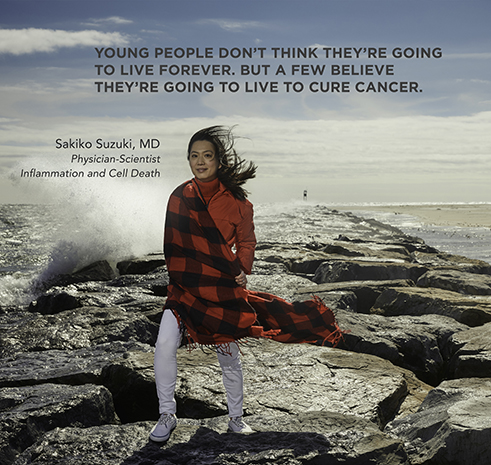
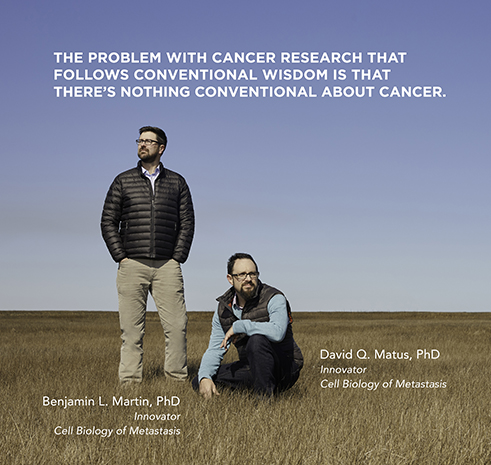
To accelerate breakthroughs, the Damon Runyon Foundation provides today's best young scientists with funds to pursue innovative cancer research.
- Today’s Promising Areas of Cancer Research
- What is Cancer?
- A Broken Pipeline?
A Generation of Science at Risk
- ARISE Report
Early Career Scientists and High-Risk, High Reward Research - American Academy of Arts and Sciences
- Why We’re Losing the War on Cancer (And How To Win It)
Clifton Leaf - Fortune Magazine
August 17, 2010 > New understanding of lung tumor resistance to Tarceva
Raffaella Sordella, PhD (Island Outreach Foundation Innovator ‘10-‘12) of Cold Spring Harbor Laboratory, Cold Spring Harbor, reported the discovery of a subpopulation of cells in non-small cell lung cancer (NSCLC) tumors that are intrinsically resistant to the targeted therapy erlotinib/Tarceva. These cells have features suggestive of a fate change termed epithelial-to-mesenchymal transition (EMT), and the researchers showed that these features are dependent on signaling by TGF-β and secretion of a factor called IL-6. Both TGF-β and IL-6 trigger inflammation. Interestingly, this study suggests that inflammation (e.g., in the tumor microenvironment) can reduce the tumor response to Tarceva; this represents an important new understanding of how tumor cells develop resistance. These findings were published in the journal Proceedings of the National Academy of Sciences.